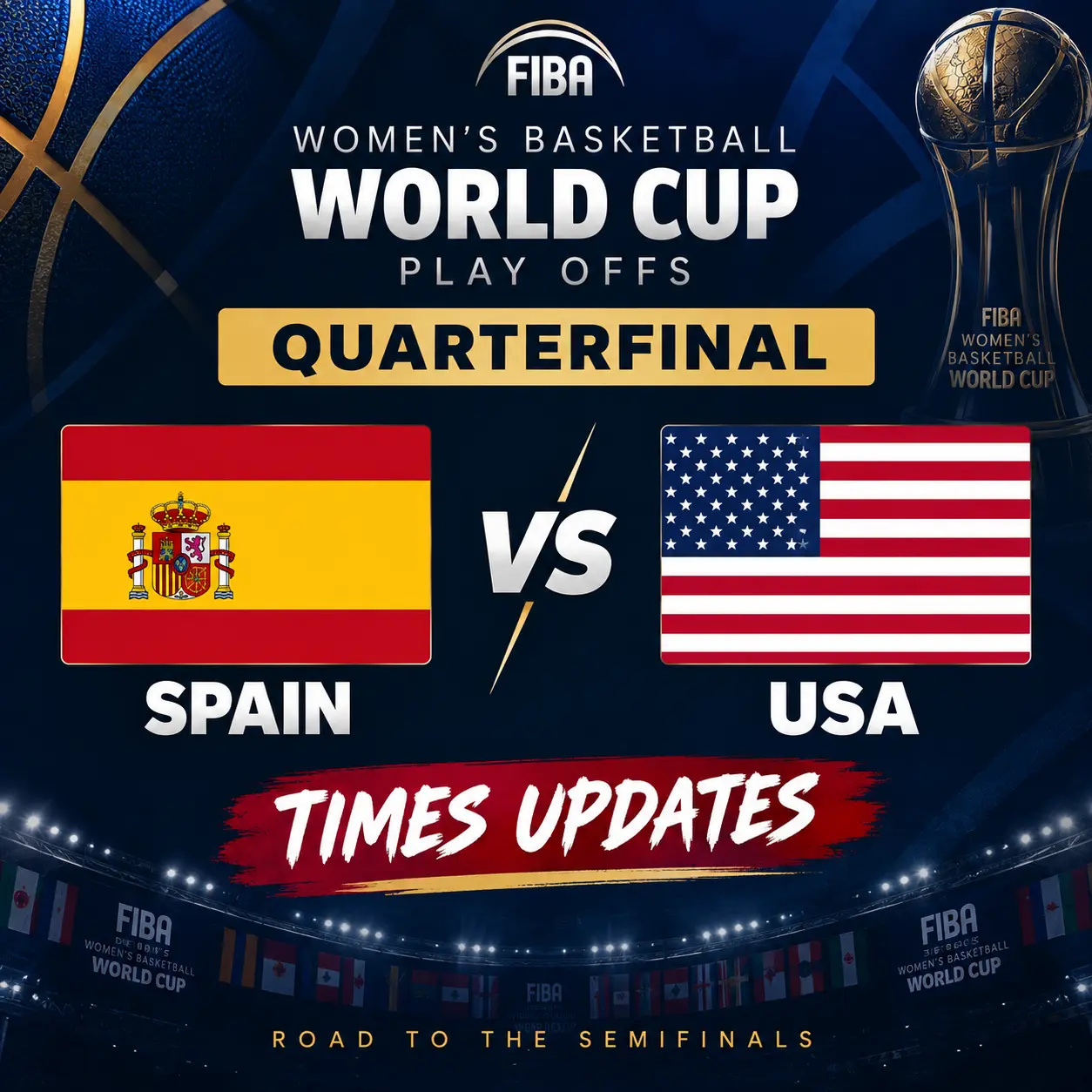
🚨 FIBA QUARTERFINAL ALERT: IT’S OFFICIAL — TEAM USA WILL FACE SPAIN IN A HIGH-STAKES BATTLE FOR A SPOT IN THE SEMIFINALS
The stage is set.
After days of anticipation, speculation, and increasingly intense competition, Team USA now knows exactly what stands between them and a place in the FIBA semifinals: Spain.
And this is not the kind of matchup anyone inside the American locker room can afford to take lightly.
Team USA will meet Spain in a high-stakes quarterfinal showdown where there is no margin for error, no second chance, and no opportunity to recover from a bad night.
Win, and the championship dream continues.
Lose, and the tournament is over.
That simple reality transforms this game from another international matchup into one of the biggest tests Team USA has faced during its tournament run.
The Americans enter the quarterfinal carrying enormous expectations. Every time USA Basketball steps onto the international stage, winning is not simply the goal — it is the standard.
But Spain represents the kind of opponent capable of turning expectations into pressure.
Disciplined, experienced, technically sharp and traditionally comfortable in high-pressure international basketball, Spain has the tools to make Team USA work for every possession.
This will not simply be about talent.
It will be about execution.
It will be about discipline.
And above everything else, it will be about which team handles the pressure of elimination basketball better.
TEAM USA ENTERS THE DANGER ZONE
Tournament basketball changes dramatically when the knockout rounds begin.
Earlier games provide opportunities to learn, experiment and recover. A team can survive a difficult quarter, an inefficient shooting night or even a disappointing result and still have another opportunity.
The quarterfinals offer no such luxury.
Forty minutes can determine everything.
One defensive breakdown can matter.
One turnover can change momentum.
One missed rebound can lead to a season-defining shot.
That is why Team USA's meeting with Spain carries a completely different emotional weight.
The Americans may possess tremendous individual talent, but talent alone does not guarantee survival at this stage of international competition.
Spain will understand that.
The Spanish game plan is unlikely to revolve around trying to defeat Team USA through pure athleticism. Instead, expect Spain to search for ways to disrupt rhythm, control tempo and force the Americans into uncomfortable half-court possessions.
Every possession becomes a battle of patience.
Every defensive rotation becomes important.
And every mistake becomes increasingly expensive.
For Team USA, the challenge will be maintaining aggression without becoming reckless.
CAITLIN CLARK STEPS INTO THE QUARTERFINAL SPOTLIGHT
Few players will attract more attention entering this matchup than Caitlin Clark.
Clark has spent much of her basketball career playing under extraordinary scrutiny. From packed college arenas to the professional stage and now international basketball, attention has followed almost every step of her journey.
But elimination basketball presents another kind of test.
Against Spain, the question will not simply be how many points Clark can score.
It will be how she manages the game when Spain attempts to take away her preferred options.
Clark's shooting range can stretch a defense well beyond the three-point line. Her passing can punish aggressive traps. Her ability to accelerate the offense can turn a defensive rebound into a scoring opportunity within seconds.
Those qualities make her dangerous.
They also make her an obvious focus of Spain's defensive preparation.
Spain could attempt to pressure Clark early, deny comfortable ball screens and force other American players to initiate the offense.
If that happens, patience will become critical.
Clark does not need to force spectacular plays on every possession.
Sometimes the most important decision will be the simplest one: make the correct pass, relocate, draw defenders and allow the offense to create another advantage.
Quarterfinal games are often decided by players who understand when to attack and when to wait.
For Clark, this could become one of those defining tests.
KARA LAWSON'S BIGGEST STRATEGIC CHALLENGE
The pressure will not exist only on the court.
Head coach Kara Lawson enters the matchup facing a series of important decisions.
How aggressively should Team USA attack in transition?
How should the Americans defend Spain's half-court actions?
Which lineup combinations provide the best balance between spacing, defense and rebounding?
And perhaps most importantly, how quickly should Lawson adjust if Spain succeeds in slowing the game?
International knockout basketball frequently becomes a coaching chess match.
The first game plan matters.
The response to the opponent's adjustments matters even more.
Spain will almost certainly arrive with specific ideas designed to make the Americans uncomfortable.
Lawson and her staff must recognize those adjustments quickly.
There may be moments when Team USA needs speed.
There may be moments when the Americans need size.
There may also be stretches when the smartest decision is simply to slow everything down and execute.
The quarterfinal will test Lawson's ability to read the game in real time.
One substitution can alter a matchup.
One timeout can stop momentum.
One defensive adjustment can change the entire fourth quarter.
At this stage, those details are often the difference between advancing and going home.
SPAIN HAS NOTHING TO FEAR
One of the most dangerous mistakes Team USA could make would be assuming that Spain will enter the game intimidated.
Spain's basketball tradition suggests exactly the opposite.
Spanish basketball has long emphasized fundamentals, movement, spacing and tactical awareness. Players are typically comfortable operating within structured systems, and international competition is deeply embedded in the country's basketball culture.
That matters in elimination games.
When pressure increases, disciplined teams often become even more difficult to defeat.
Spain does not necessarily need to dominate every statistical category.
It needs to remain close.
If Spain can keep the score within striking distance entering the fourth quarter, pressure could begin shifting toward the Americans.
Suddenly, every missed Team USA shot would feel bigger.
Every Spanish three-pointer would become louder.
Every whistle would carry additional significance.
That is precisely the scenario Team USA will want to avoid.
The Americans' ideal approach would be to establish control early, dictate tempo and prevent Spain from becoming increasingly confident as the game progresses.
But doing that will require consistent execution.
Spain is unlikely to disappear simply because Team USA builds an early lead.
THE BATTLE FOR TEMPO
Perhaps the most fascinating tactical question surrounding the quarterfinal is pace.
Team USA possesses athletes capable of turning defense into offense almost instantly.
A steal can become a layup.
A blocked shot can become a transition three.
A long rebound can trigger a fast break before Spain has time to organize its defense.
That is where the Americans can be devastating.
Spain's priority, therefore, could be preventing those situations.
If Spain can reduce turnovers, retreat quickly and force Team USA to execute against a set defense, the game could become far more complicated.
That creates an important battle within the battle.
Team USA wants controlled chaos.
Spain wants structure.
The team that successfully imposes its preferred rhythm could gain an enormous advantage.
For the Americans, defensive pressure will be essential.
But aggression must remain disciplined.
Reaching unnecessarily, gambling for steals or losing defensive positioning could create easy opportunities for Spain.
The goal is not simply to play fast.
It is to create the conditions that allow Team USA to play fast.
THE REBOUNDING BATTLE COULD DECIDE EVERYTHING
There is another area that rarely receives the same attention as highlight plays but could determine the outcome: rebounding.
In elimination basketball, giving an opponent multiple opportunities on the same possession can be devastating.
Team USA cannot afford to defend Spain well for 20 seconds only to surrender an offensive rebound and restart the possession.
Likewise, offensive rebounds could become an important weapon for the Americans.
Second-chance points do more than affect the scoreboard.
They damage morale.
There are few things more frustrating for a defense than forcing a difficult miss and then watching the opponent recover the ball.
The Americans' guards will need to contribute as well.
Rebounding cannot simply be left to the frontcourt.
Long three-point attempts often produce long rebounds, meaning perimeter players must remain alert and physical.
Those possessions may never appear in a highlight reel.
But they win tournament games.
TEAM USA'S DEPTH COULD BECOME ITS GREATEST WEAPON
One of the Americans' biggest advantages is the number of players capable of changing a game.
In a tournament setting, depth becomes increasingly important.
Fatigue accumulates.
Physical contact takes its toll.
And opponents become more familiar with tendencies.
Team USA's ability to rotate players without dramatically sacrificing athleticism or scoring potential can create relentless pressure.
If Spain successfully limits one American scorer, another must be ready.
If Clark receives aggressive defensive attention, teammates must punish the extra coverage.
If the starting unit struggles, the bench must provide energy rather than simply maintain the score.
Championship teams rarely survive because one superstar rescues them every night.
They survive because different players step forward at different moments.
That could become one of the defining themes of this quarterfinal.
DEFENSE MUST TRAVEL
Shooting can disappear without warning.
Even great shooters experience cold stretches.
That is why defense becomes so important in knockout basketball.
Team USA cannot assume its shots will fall from the opening possession.
There may be stretches when three-pointers miss.
There may be possessions when Spain's defense disrupts passing lanes.
There may be moments when the offense looks uncomfortable.
Defense provides stability during those stretches.
The Americans must communicate through screens, protect the paint and close out under control.
Spain will search for breakdowns.
A late rotation could produce an open three.
A poor switch could create a mismatch.
A moment of ball-watching could create a backdoor cut.
These mistakes become magnified in the quarterfinals.
Team USA's best defense will not necessarily be the one producing the most spectacular steals.
It will be the one consistently forcing Spain into difficult decisions late in the shot clock.
THE FIRST FIVE MINUTES MATTER
How Team USA begins the game could reveal a great deal.
The Americans will want energy without panic.
Aggression without unnecessary risk.
Confidence without complacency.
Spain, meanwhile, could attempt to absorb the initial pressure and quiet the American momentum.
If Team USA opens with transition baskets, defensive stops and strong rebounding, the game could quickly move toward the Americans' preferred style.
But if Spain slows the opening possessions and begins hitting shots, the psychological dynamics could change.
Suddenly Spain begins believing.
The bench becomes louder.
Every defensive stop generates confidence.
That is why Team USA must treat the opening minutes seriously.
There is no reason to panic if Spain starts well.
But there is also no reason to give an experienced opponent unnecessary confidence.
THEN COMES THE FOURTH QUARTER
If the game remains close, everything changes in the final ten minutes.
Playbooks become smaller.
Possessions become longer.
Stars receive more touches.
Defensive intensity rises.
And decision-making becomes increasingly important.
This is where Team USA's leadership will be tested.
Who wants the ball when the game tightens?
Who makes the extra pass?
Who communicates after a defensive mistake?
Who remains composed after a controversial whistle?
Who attacks the glass when everyone else is watching the shot?
Those moments separate talented teams from championship teams.
Clark could find herself at the center of several of them.
Spain will know exactly how dangerous she can be with space late in games.
Expect defenders to stay attached to her well beyond the arc.
That attention could create opportunities elsewhere.
Clark's biggest fourth-quarter contribution might be a deep three.
Or it might be the pass that creates someone else's open shot.
Either way, decision-making will matter more than individual statistics.
PRESSURE BELONGS TO TEAM USA
There is no avoiding the reality surrounding American basketball.
Team USA is expected to win.
That expectation follows the jersey everywhere.
Opponents often enter games against the Americans with something to prove.
They can play freely.
Team USA rarely enjoys that psychological luxury.
A close game produces questions.
A poor quarter creates criticism.
A loss becomes a national conversation.
But pressure does not necessarily have to become a weakness.
It can become fuel.
The players representing Team USA understand why expectations are so high.
They are wearing a jersey associated with generations of elite basketball talent.
That history does not guarantee victory.
It demands preparation.
SPAIN WILL TRY TO TURN PRESSURE INTO DOUBT
Spain's clearest route to an upset may involve staying close long enough for Team USA to begin feeling the weight of the moment.
Imagine the scenario.
Five minutes remain.
The score is separated by one possession.
Spain has the ball.
The crowd senses something unexpected could happen.
Every American possession suddenly feels enormous.
That is when composure becomes priceless.
Team USA must avoid allowing the scoreboard to dictate emotion.
Whether leading by 15 or trailing by three, the next possession requires the same discipline.
Championship basketball is often remarkably simple.
Defend.
Rebound.
Protect the ball.
Take good shots.
Repeat.
The difficulty is maintaining those principles when pressure makes everything feel complicated.
ONE GAME FROM THE SEMIFINALS
Ultimately, that is what makes this matchup impossible to ignore.
Team USA is one victory away from the semifinals.
Spain is one victory away from ending the Americans' run.
There are no complicated scenarios.
No standings calculations.
No opportunities to recover later.
Just one game.
Forty minutes.
Two basketball nations.
One semifinal ticket.
For Team USA, the path forward demands focus.
The Americans must respect Spain without fearing Spain.
They must attack without becoming careless.
They must trust their talent without relying on talent alone.
And they must understand that championship aspirations mean very little if they cannot survive the quarterfinal in front of them.
For Spain, the opportunity is enormous.
Beat Team USA and the tournament changes instantly.
The Spanish players will know that.
They will arrive believing that if they can withstand the Americans' athleticism, control the pace and keep the game close, pressure could create an opportunity.
That makes the opening whistle especially important.
EVERYTHING IS NOW ON THE LINE
There is something different about knockout basketball.
The atmosphere feels heavier.
Every basket generates a stronger reaction.
Every mistake hurts more.
Players understand that months or even years of preparation can come down to a handful of possessions.
Team USA versus Spain carries all of those ingredients.
Star power.
International history.
Contrasting styles.
Tactical intrigue.
Enormous expectations.
And a place in the semifinals waiting on the other side.
For Caitlin Clark and Team USA, this is another opportunity to prove that they can perform when the stakes become uncomfortable.
For Kara Lawson, it is a test of preparation, adjustment and leadership.
For Spain, it is an opportunity to shock the tournament and eliminate one of international basketball's most feared programs.
Nothing is guaranteed now.
Not reputation.
Not rankings.
Not predictions.
The only thing that matters is what happens once the ball goes into the air.
Team USA has reached the qu