Chapter 1 - The Weight of Steel and Silk
 The ballroom of the Grand Harbor Hotel smelled of expensive lilies, dry ice, and the faint, coppery tang of heated brass. Beneath the vaulted ceiling, where crystal chandeliers clustered like frozen constellations, three hundred members of the maritime defense establishment stood in small, self-satisfied circles. Men in midnight-blue mess dress uniforms with gold bullion gleaming on their cuffs traded quiet nods with executives whose tuxedo lapels bore the discreet pins of major aerospace and naval conglomerates.
I stood two inches to Derek’s left, which was where he liked me: close enough to complete the portrait of a rising corporate vice president, but half a step back so that his silhouette remained unobstructed.
"Chin up, Mara," Derek murmured without turning his head. His teeth were white, fixed in that easy, camera-ready grimace he had spent ten minutes perfecting in our apartment mirror before the Uber arrived. "Frank Vance from Raytheon is glancing over. Don't look tired. We talked about this. You look tired, people think our division is stressed."
"I’m not tired, Derek," I said quietly. "My foot aches."
"It’s an evening event. Everyone’s feet ache."
"My left foot aches because my right one is doing twice the mechanical work to keep me upright on this carpet."
Derek gave a low, dismissive chuckle, the kind that was meant to sound playful to anyone watching from ten feet away while delivering a clean, sterile rebuke to the person standing beside him. "Let’s not start the technical explanations now, honey. It’s an emerald dress. You look stunning. Just let people look at the dress."
That was Derek’s gift. He had an uncanny ability to reduce every complex reality into a cosmetic issue. To him, my prosthetic leg—a high-activity modular system constructed from cured carbon fiber, aircraft-grade aluminum, and an oil-damped micro-hydraulic knee unit—was simply an aesthetic inconvenience. It was a detail to be managed, hidden beneath floor-length skirts, or mentioned in hushed, slightly tragic tones when he needed to demonstrate his own boundless capacity for patience to his colleagues.
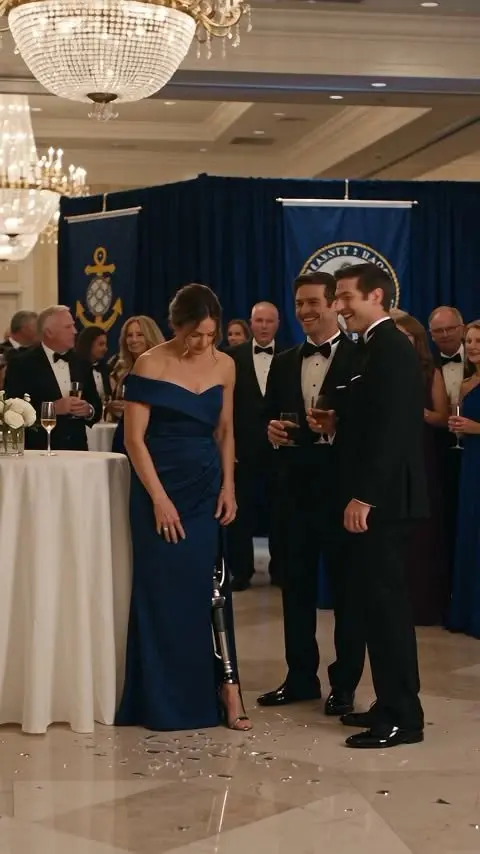
We took four steps toward table four. The carpet was thick, an ornate wool runner laid over heavy padding that swallowed sound and dragged at the toe of my shoe. My left heel caught in a subtle fold of the fabric. It wasn't a violent stumble, but with an artificial limb, proprioception is an illusion bought through bone-conduction and socket pressure; when the left foot falters, the right knee cannot instinctively micro-correct.
My hip torqued. I reached out, my fingers skimming the polished edge of a high-top cocktail table, catching my weight before I hit the floor. The stemware rattled against the glass top, a sharp, ringing percussion that drew eyes from three adjacent tables.
In the sudden shift, the high slit of my emerald silk gown fell back.
The fabric parted to mid-thigh. Under the merciless glare of the chandelier, the hardware of my right leg was entirely exposed: the matte-black carbon composite socket gripping my residual limb, the silver anodized pylons, the industrial-grade hex bolts, and the robotic silhouette of the polycentric hydraulic joint.
The immediate reaction was a familiar, suffocating hush. A junior vice president from General Dynamics looked down, blinked, and violently snapped his gaze toward the ceiling. His wife pressed a manicured hand to her collarbone, her mouth forming a small, patronizing *O* of social pity.
Derek did not reach out to steady me. His hands remained at his sides, his fists tightening until the fabric of his dinner jacket strained across his shoulders. I saw the sudden flush of red rising from beneath his stiff white collar. It wasn't concern. It was the naked, indignant fury of a man who believed his car had just been scratched in the driveway of a country club.
Then, he did what Derek always did when trapped between social shame and the desire to dominate the room: he weaponized it.
He let out a bark of laughter, sharp and theatrical.
"Don't worry about Mara, folks!" he announced, raising his voice so that it carried cleanly across the velvet-draped perimeter of tables four, five, and six. He shook his head, offering an exaggerated roll of his eyes to Frank Vance. "She's only half a woman on a good day. I'm basically running a charitable foundation just getting her through the front door of these things."
The silence that followed was fragile, like thin ice over stagnant water.
Then, two men near the bar chuckled—that dry, sycophantic sound men make when they aren't sure if a joke is funny, but they know the speaker's father sits on the executive board. A woman in sequins gave a tight, nervous giggle, looking down into her champagne glass.
I stood there, my hand still resting against the mahogany edge of the table, feeling the cold air conditioning against the bare skin of my upper thigh. I felt the rigid carbon frame digging into the scar tissue above my knee.
Derek looked at me, his smile fixed, his blue eyes hard as river pebbles. *Play along,* his eyes said. *Smile. Don’t make me look small.*
Across the wide expanse of the ballroom, the sound of breaking crystal was not loud, but it was absolute.
It was the clean, violent shatter of a heavy highball glass hitting marble.
The laughter died instantly. Not a slow fade, but an abrupt, total severing. The background hum of three hundred conversations evaporated, leaving only the low, mechanical drone of the hotel’s air filtration system.
In the center aisle, directly beneath the grand seal of the United States Navy suspended from the mezzanine, a man stood motionless.
He was seventy-eight years old, six feet two inches of straight, unyielding line, wearing the dark Navy service dress uniform with four stars blazing on each shoulder board. His chest was an unbroken wall of campaign ribbons, dominated by the pale blue ribbon of the Medal of Honor, its tiny white stars stark against the silk. Admiral Thomas Reddick. The man who had commanded two carrier strike groups, who had rewritten modern littoral warfare doctrine, and whose retirement had done nothing to diminish the terror his name inspired in procurement officers who tried to cut corners on hull integrity.
A broken tumbler lay in wet pieces around his polished dress shoes. Scotch pooled across the white marble border of the carpet.
His face was the color of weathered granite.
Derek’s breath hitched. He dropped his gaze to the spilled glass, then looked back at me, his face pale with sudden, panicked calculation. "Jesus, Mara," he hissed under his breath, his lips barely moving. "Look what you did. He was listening to the noise from this table."
"Derek—"
"Shut up. Sit down." Derek grabbed my left forearm, his fingers digging hard into the muscle, trying to force me into the nearest banquet chair. "Sit down before this gets worse. He's coming over here. He's going to tear someone apart for decorum."
The Admiral was moving.
He did not walk with the hurried step of an angry old man; he marched with the slow, terrifying cadence of an approaching front. His shoes clicked against the marble border with the precision of a metronome. The crowd parted before him like water before a prow. Men in uniform snapped their spines straight as he passed, their hands instinctively moving toward their trouser seams, but Reddick looked at none of them. His pale gray eyes were locked on our table.
Derek took a deep, shuddering breath, released my arm, and stepped out into the aisle. He threw his shoulders back, smoothed his satin lapels, and assembled the posture of an executive preparing to defuse a subordinate's blunder.
"Admiral Reddick, sir," Derek began, his voice dropping into its most resonant, deferential register. He extended a hand. "I am Derek Halston, Vice President of Strategic Accounts for Halston Marine. Sir, on behalf of our company, I want to apologize profusely for the distraction. My fiancée had a slight mechanical difficulty with her footing, and—"
Reddick didn't stop. He didn't even look at the outstretched hand.
"Move," Reddick said.
The word was not shouted. It was delivered with the flat, chilling finality of an anchor dropping into deep water.
Derek froze. His hand hung suspended in the empty air between them. "Sir, if I could just explain that Halston Marine’s proposal for the—"
"I said move out of my way, son," Reddick repeated, his voice dropping an octave. "Before I have the Shore Patrol carry you out by your cummerbund."
Derek stepped backward so quickly his heel struck the base of the banquet chair, nearly sending him sprawling. His face drained of all color, leaving him looking hollow, slack-jawed, and utterly bewildered.
The Admiral stepped past him.
He stopped thirty inches from where I stood.
For five seconds, the entire room was so quiet that I could hear the faint hum of the refrigeration units behind the service doors. Reddick’s eyes swept down my frame. They lingered on the exposed carbon-fiber pylon of my right leg, took in the surgical scars visible just above the suspension sleeve, and then rose slowly to meet my face.
The hard, predatory lines around his mouth softened. The gray eyes, which had sent admirals and congressmen into stuttering retreats for forty years, grew suddenly, remarkably bright.
"Mara?" he whispered.
My throat closed. The ballroom, the chandeliers, Derek’s terrified breathing three feet away—all of it seemed to dissolve into a gray fog of memory, replaced by the smell of diesel fuel, burning insulation, and the terrifying, black roar of seawater rushing through a breached bulkheading.
"Yes, sir," I managed, my voice steady despite the hammer of my heart.
"Lieutenant Commander Ellison?"
A collective gasp rippled through the nearest tables. Frank Vance’s mouth actually fell open. Beside me, Derek looked as though someone had struck him across the bridge of the nose with an iron pipe.
"It’s been ten years, Admiral," I said quietly.
Reddick took a slow, shuddering breath. His chest rose, the medals clinking softly against each other—a quiet, metallic music that seemed to command the absolute attention of every living soul in that hall.
"Ten years," he murmured. "Ten years of searching personnel registries that your friends in the Bureau kept redacting on your behalf."
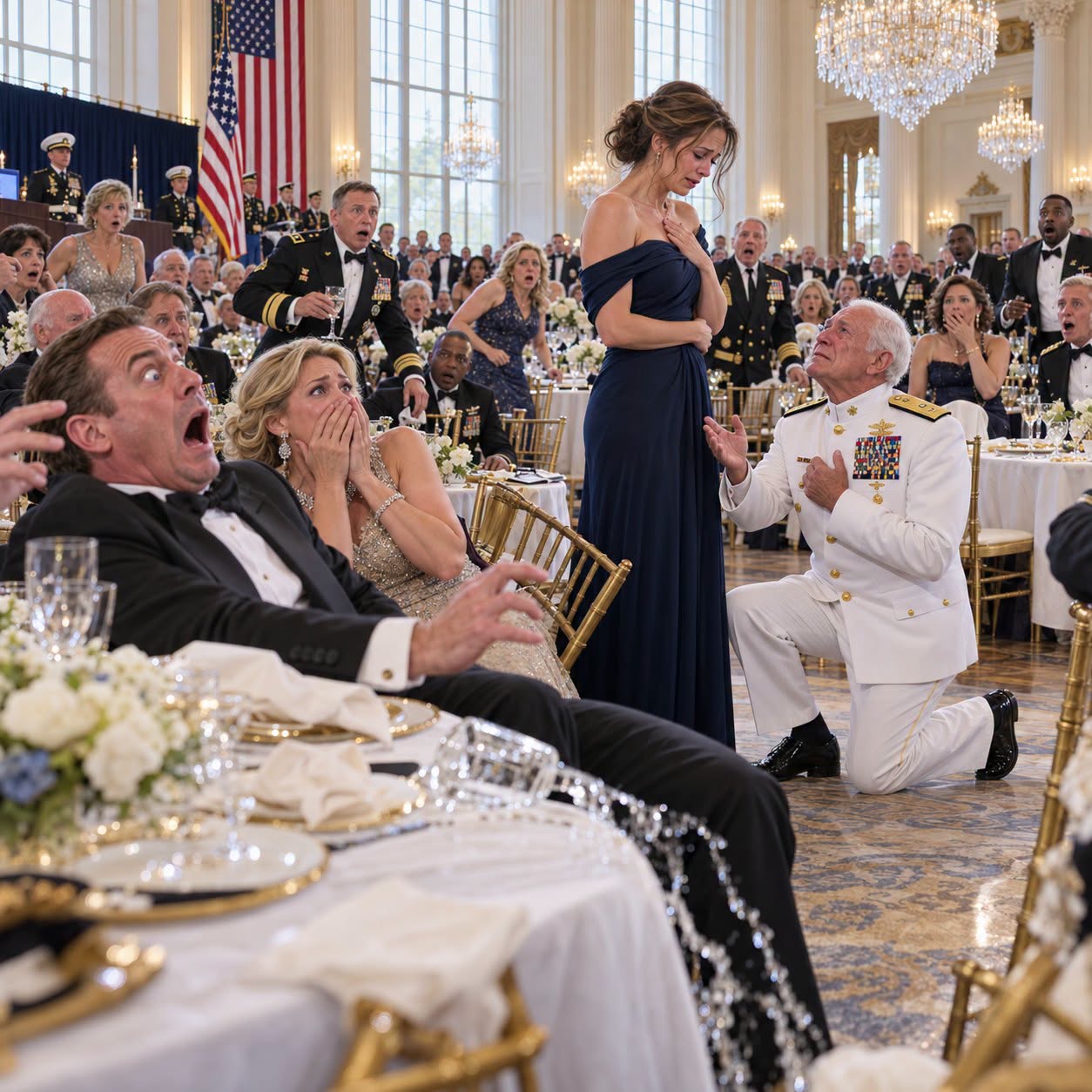
Then, Thomas Reddick—the legendary terror of the Pacific Fleet, a man who had not bowed his head to presidents—did something that made four defense contractors at table two drop their forks onto their china.
He brought his polished heels together with a sharp, crisp *clack*.
He raised his right hand to the brim of his dress cover, executing a salute so rigid, so formally perfect, that it looked as though it belonged on the deck of a battleship during a state funeral.
My spine straightened on instinct. The muscle memory of twelve years of service surged through my nerves, overriding the dull ache in my left hip, overriding the clumsy weight of the prosthetic. I brought my hand up, snapping a salute back.
"Commander," he said, his voice carrying clearly to every corner of the frozen room, "lower your hand."
I lowered it.
Reddick did not drop his arm to his side. Instead, he stepped forward, bent his tall frame, and dropped his right knee squarely onto the hard marble floor in front of me.
A strangled sound came from Derek’s throat: *"Babe...?"*
Reddick didn't care. The old warrior knelt on the floor, reaching out with hands that trembled slightly with age and emotion, and gently gathered the hem of my emerald silk gown. With the deliberate, reverent care of a priest tending an altar, he drew the fabric down, smoothing it over the black composite socket, over the titanium pylon, until the mechanical joints were once again covered and protected from the staring eyes of the room.
He looked up at me from the floor, his eyes wet.
The Admiral rose slowly. He did not use the table for leverage; he used the strength of his own legs, rising with an athletic discipline that defied his seventy-eight years. When he was fully upright, he turned his head five degrees to the right, his eyes fixing Derek Halston with a look that would have withered an oak tree.
"You," Reddick said.
Derek swallowed. He looked around wildly, hoping to find a sympathetic glance from one of his corporate mentors, but Frank Vance had suddenly found his bread roll deeply fascinating, and the other executives were leaning back, distancing themselves as if Derek were covered in fuel oil.
"Admiral," Derek stammered, raising his hands in a placating gesture. "I—I think there’s been a profound misunderstanding. Mara and I—we joke. It’s our dynamic. It was just a bit of lighthearted self-deprecation on her behalf, through me—"
"You called her half a woman," Reddick said. The words were flat, dead, devoid of inflection. That made them infinitely more terrifying than a shout.
"It was an ill-conceived joke, sir. A slip of the tongue—"
"A slip of the tongue," Reddick mused. He stepped closer to Derek, closing the distance until his ribbons were nearly touching the lapels of Derek’s tailored dinner suit. Derek seemed to shrink, his shoulders rolling inward, his chin tucking toward his throat. "A man who cannot control his tongue in a public room has no business managing defense accounts. And a man who insults an officer who gave her body to drag seven sailors from a burning auxiliary machine space is not a man at all. He is a parasite wearing an expensive coat."
"Now see here, Reddick," a voice started from the neighboring table—Arthur Halston, Derek’s uncle and the senior partner of the firm. Arthur had risen, his face mottled red. "Derek is an officer of my company, and this is a private industry event—"
Reddick didn't even turn his head. "Sit down, Arthur, before I call the Secretary of the Navy’s procurement ethics board from this very room and have your firm’s security clearance suspended pending an audit of your subcontracting practices in Subic Bay."
Arthur Halston shut his mouth and sat down so hard his water goblet sloshed over his linen napkin.
The Admiral turned his back on them entirely. He looked at me, his eyes soft once more. "Mara, my dear. Have you eaten?"
"No, sir. We had just arrived."
"Good," Reddick said, offering his arm with an old-world elegance that felt entirely foreign in this room of transactional glad-handing. "The food at table four is undoubtedly cold and tastes of corporate ambition. You will sit at the head table with me. Julian is arriving in twenty minutes. He took the late shuttle from Norfolk."
The name hit me like a physical wave. *Julian.*
"Julian is here?" I asked, my voice barely more than a whisper.
"He wouldn't miss tonight," Reddick said, his smile finally reaching his eyes. "He was told the keynote speaker was a pompous old blowhard, but he felt obligated to support the family anyway. Come."
I looked at Derek.
He was staring at me with a mixture of disbelief, humiliation, and a sudden, sickening dawn of realization. He saw his three-year courtship of me not as the gracious act of charity he had imagined, but as a door he had kept locked without ever realizing who held the key.
"Mara," Derek whispered, his voice trembling with desperation. "Mara, please. Let's talk about this outside. We’re engaged. We have a life together. You can't just walk away with—"
I looked down at the three-carat diamond ring on the fourth finger of my left hand.
I remembered the day he gave it to me: on a manicured lawn outside his parents' summer home in Martha’s Vineyard, with a hired photographer hiding in the hydrangeas to capture the moment for his LinkedIn announcement. He had told me then that he loved my "resilience." He had never once asked me what that resilience had cost.
I slipped the ring off my finger. The platinum felt heavy and cold against my skin.
I didn't throw it at him. I didn't drop it into his champagne glass like a heroine in a melodrama. I simply reached out and placed it carefully on the edge of the tablecloth beside his unused butter knife.
"You were right about one thing, Derek," I said, my voice level, clear, and utterly calm. "You were running a charity. But it wasn't for me."
I turned, placed my gloved hand on the crisp wool of Admiral Reddick's sleeve, and let him lead me toward the dais.
As we walked down the center aisle, the room seemed to shift on its axis. The whispers were no longer dismissive; they were ferocious, urgent, and terrified. Procurement specialists who had ignored my emails for six months suddenly stood up, leaning forward with deferential smiles that I ignored completely.
"Your gait has improved, Commander," Reddick murmured as we ascended the three low steps to the raised platform. "The naval hospital at Bethesda told me you were refusing the sedentary pension and demanding field-testing clearance for new carbon-fiber designs."
"I don't like sitting behind desks, sir," I replied. "And the commercial shipping yards don't care how many legs an engineer has, as long as she can tell why a high-pressure steam valve failed at four hundred degrees."
"They will care tomorrow," Reddick said darkly as he pulled out the heavy mahogany armchair directly to the right of the podium—the seat reserved for the Undersecretary of Defense, who had cancelled that morning. "Tomorrow, everyone in this harbor is going to know exactly who has been checking their hull tolerances."
I sat down, the emerald silk falling naturally around my legs. From this vantage point, the ballroom looked different. It looked smaller. Derek was still standing by table four, surrounded by his uncle and two senior partners, all of them gesticulating wildly, their faces twisted in frantic argument.
Derek looked up, his eyes meeting mine across the glittering expanse of silver and crystal.
For three years, I had molded myself to his ambitions. I had swallowed his subtle cuts, his condescending jokes, his insistence that my past was a closed book that had no relevance to his bright, corporate future. I had let him believe that I was lucky to have him because the alternative—explaining the nightmares, the phantom pain that kept me awake at three in the morning, the screaming steam pipes that still echoed in my ears—was too exhausting to bear with a man who lived on the surface of things.
A waiter appeared at my elbow, his hands shaking slightly as he poured water from a silver pitcher.
"Thank you," I said.
The waiter looked at me, then at the four-star Admiral standing beside my chair like a sentry, and swallowed hard. "A—an absolute honor, Commander."
The word hung in the air, sweet and sharp as sea salt.
Ten years ago, I had stripped that uniform off in a sterile room in San Diego, convinced that my life had ended when the steel hatch slammed shut on my lower right leg. I had spent a decade believing that survival was merely an administrative task to be carried out quietly, without bothering anyone.
May you like
I looked at the head table, at the heavy naval seal hanging above us, and felt the first true, steady beat of my heart in a very long time.
***
Previous Chapter 1 - The Weight of Steel and Silk View intro Gala Dinner. My Dress Slipped. "She's Half A Woman At Best." The Table Burst Into Laughter. The Decorated Four-Star Admiral Dropped His Glass And Walked Straight Toward Me. The Room Went Dead Silent. "Babe, Sit Down. He's Coming To Reprimand Her!" The 78-Year-Old War Hero Dropped To One Knee.