“TIME FOR THE 25TH!”: Gavin Newsom Calls for Constitutional Action Against Trump as Remarks About Los Angeles and San Diego Ignite Political Firestorm
October 8, 2026 | U.S. Politics
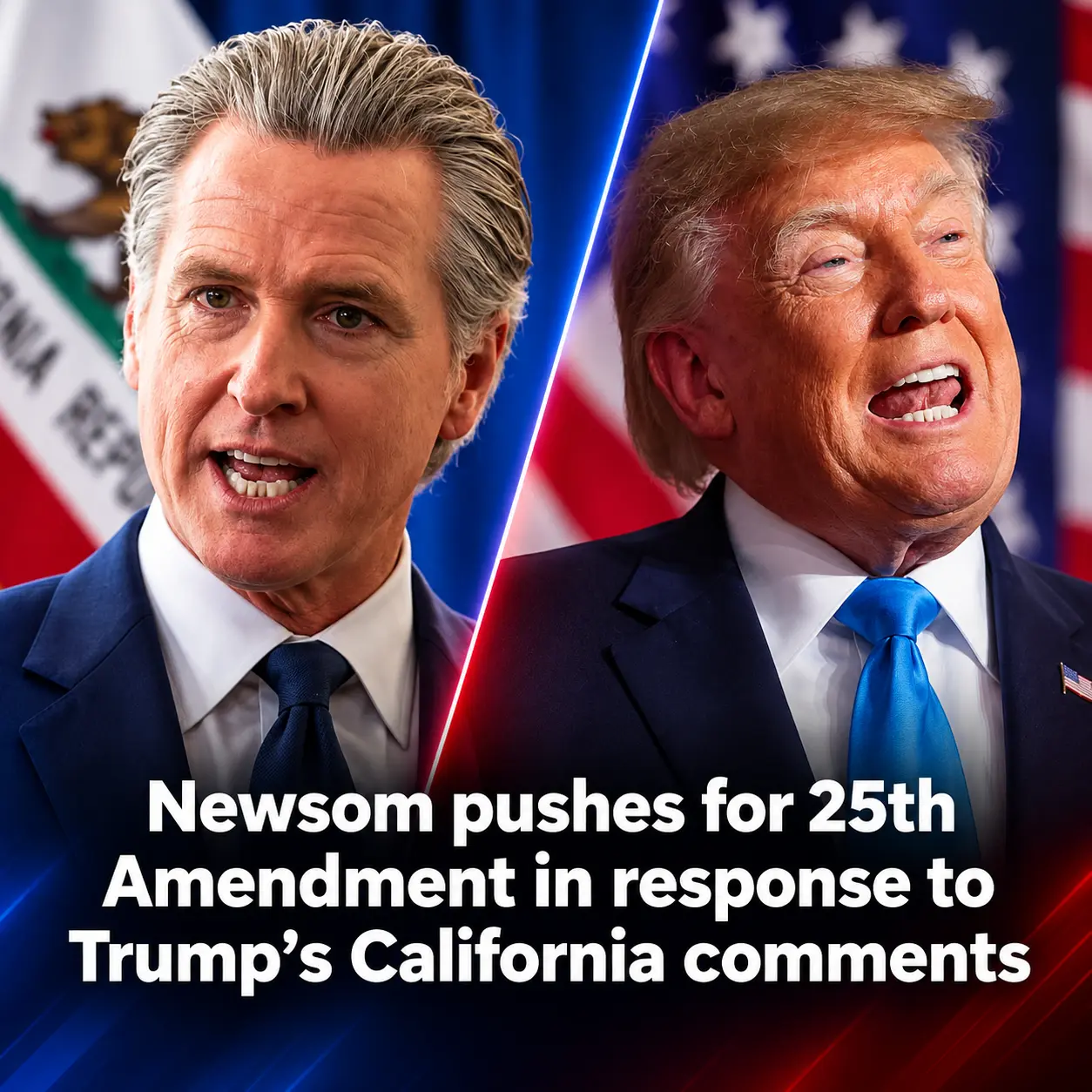
California Governor Gavin Newsom has intensified his confrontation with President Donald Trump, calling for the invocation of the 25th Amendment after remarks about Los Angeles and San Diego sparked widespread criticism and renewed questions about presidential rhetoric during a period of international conflict.
The controversy began with Trump's comments at a political rally in Grand Island, Nebraska, where he defended the war with Iran and addressed the economic costs of the conflict. His remarks appeared to suggest that an Iranian attack on major American cities could be an acceptable consequence of efforts to prevent Iran from becoming a nuclear-armed power.
Newsom responded with an unmistakable message: “TIME FOR THE 25TH!”
The California governor also directed the state's threat assessment authorities to monitor potential security concerns, while political leaders from both major parties criticized the president's language.
The White House rejected the interpretation offered by Newsom and other critics, arguing that Trump was describing the dangers that a nuclear-armed Iran could pose to American cities, rather than expressing willingness to sacrifice them.
The dispute has now expanded beyond a disagreement over presidential rhetoric. It has become a debate about national security, constitutional authority, political accountability, and the limits of the 25th Amendment.
Editor's note: This article is based on the account provided. The reported statements and developments have not all been independently verified. Allegations, political interpretations, and established constitutional procedures are distinguished throughout.


4
The Nebraska Remarks That Started the Controversy
The confrontation began on Monday, October 5, during Trump's appearance in Grand Island, Nebraska.
Speaking to supporters, the president defended his administration's approach to Iran, including the financial and economic consequences of the conflict.
The war has affected energy markets and contributed to concerns about gasoline prices, an issue with direct consequences for American households.
Trump argued that the costs associated with confronting Iran should be considered against the potential dangers of allowing the country to develop nuclear weapons.
But during that argument, he referred to Los Angeles and San Diego as potential targets of an Iranian attack.
His phrasing immediately attracted attention because it appeared to place the possible destruction of American cities within a discussion about the acceptable costs of national security.
The distinction between what Trump intended to communicate and what listeners understood became central to the controversy.
Critics interpreted the remarks as suggesting that American cities could be sacrificed for a broader strategic objective.
The White House insisted that the president meant something different: that failing to confront Iran could eventually expose American cities to catastrophic danger.
Contemporary reporting from Reuters, the Associated Press, and the Los Angeles Times confirmed both the remarks and the competing interpretations.
Reuters
+2
The disagreement illustrates how presidential language can carry consequences beyond the immediate audience.
Statements made at political rallies are often directed toward supporters, but remarks involving foreign adversaries, military conflict, and American population centers are also scrutinized by diplomats, security officials, political opponents, and the wider public.
When the language is ambiguous, competing interpretations can spread rapidly.
That is precisely what happened after the Nebraska rally.
Newsom's Response: From Condemnation to the 25th Amendment

California Governor Gavin Newsom reacted forcefully.
On Monday, he characterized Trump's comments as “deranged and dangerous,” expressing concern about the implications of a president referring to the potential destruction of American cities.
By Tuesday, his criticism had escalated.
Newsom called for the use of the 25th Amendment, the constitutional mechanism that addresses presidential inability to discharge the powers and duties of office.
His message, “TIME FOR THE 25TH!”, transformed the controversy from a dispute about foreign-policy rhetoric into a discussion about constitutional authority.
Newsom also used highly critical language when discussing Trump with The Hill, including a claim about the president's mental health.
That statement was a political characterization by Newsom, not a medical diagnosis or an independently established finding about Trump's ability to serve.
The governor's demand nevertheless attracted attention because the 25th Amendment is among the most consequential provisions of the Constitution governing the presidency.
Its procedures concern the temporary or continuing transfer of presidential powers under specified circumstances.
The amendment is not simply a mechanism for removing a president over controversial statements, unpopular policies, or disagreements about foreign affairs.
Newsom's public demand did not itself initiate the constitutional process.
That distinction is essential to understanding what his statement could realistically accomplish.
The Daily Beast
+1
California Orders Threat Monitoring
Beyond his political statements, Newsom announced a security-related response.
He directed the California State Threat Assessment Center to monitor developments in case foreign actors interpreted Trump's remarks as an invitation to target California.
The center operates within the state's broader public-safety and intelligence-sharing framework.
Its purpose includes identifying potential threats, analyzing relevant information, and supporting coordination among agencies responsible for public safety.
Newsom's direction was framed as a precautionary measure rather than a response to a confirmed imminent attack.
At the time of the reported order, no specific planned Iranian attack against Los Angeles or San Diego had been publicly identified.
That distinction matters.
Threat monitoring is a routine component of security planning, particularly when public statements raise concerns about possible hostile interpretations.
It does not necessarily mean that authorities possess evidence of an operational attack plan.
The governor's decision also demonstrated how the controversy had moved from national political debate into state-level security discussions.
California officials were no longer responding only to the tone of Trump's remarks. They were considering whether those remarks required additional vigilance.
The practical effectiveness of such monitoring would depend on intelligence, interagency communication, and any credible threat information that emerged.
Why Los Angeles and San Diego Are So Significant


7
Los Angeles and San Diego are not merely two cities in a political argument.
They are major population centers with extensive economic, cultural, transportation, and national-security significance.
Los Angeles is one of the country's largest metropolitan areas and an international center for entertainment, commerce, manufacturing, logistics, and trade.
Its surrounding region includes critical transportation networks, ports, airports, and infrastructure supporting millions of residents.
San Diego is particularly important because of its extensive military presence.
The city and surrounding region host major naval facilities, military personnel, defense-related industries, and installations central to operations in the Pacific.
Reuters highlighted the importance of San Diego's military community while reporting on the reaction to Trump's remarks.
Reuters
For local officials, references to potential attacks against these cities are therefore especially sensitive.
An attack on either location would have consequences extending far beyond California.
The humanitarian impact would be enormous, while the economic and national-security implications could affect the entire country.
This context helps explain why elected officials responded so strongly.
Even hypothetical references to attacks on major American cities can raise concerns when made by the president during an active international conflict.
Local Leaders Condemn the Remarks
Newsom was not alone in criticizing the president.
Los Angeles Mayor Karen Bass and San Diego Mayor Todd Gloria also objected to the comments.
Their responses focused on public safety and the responsibilities of national leaders toward American communities.
For city officials, the immediate concern was not the technical language of the 25th Amendment.
It was the suggestion, as they understood it, that major population centers could be described as acceptable losses.
The controversy also produced criticism from outside the Democratic Party.
Jim Desmond, a Republican congressional candidate from the San Diego area, rejected the idea that any American community should be considered expendable.
His response was notable because it demonstrated that criticism of the remarks was not confined to Trump's usual political opponents.
Republican Representative Kevin Kiley also distanced himself from the president's comments, according to Reuters.
Reuters
+1
Those responses do not establish a unified bipartisan position on Trump's broader Iran policy.
Politicians can disagree with a particular statement while continuing to support other elements of an administration's agenda.
Nevertheless, the criticism showed that the controversy had crossed familiar partisan boundaries.
For leaders representing California communities, the safety of residents became the central issue.
The White House Pushes Back

The White House rejected the interpretation that Trump was encouraging or accepting attacks against American cities.
Communications Director Steven Cheung argued that the president was describing the danger that Iran could pose if it acquired nuclear weapons.
According to the administration's explanation, Trump was making the case that confronting Iran was necessary to prevent future threats against the United States.
Under that interpretation, Los Angeles and San Diego were examples of cities that could face danger if Iran's military capabilities were not constrained.
The administration therefore portrayed the criticism as a misunderstanding of the president's intended message.
The Associated Press reported Cheung's explanation, including his rejection of suggestions that Trump was advocating attacks on American territory.
AP News
This defense is important because it establishes that the central factual dispute concerns the meaning of Trump's words, not simply whether he mentioned the cities.
The comments were publicly reported.
What remains contested is how they should be understood within the broader speech.
Trump's supporters may view the remarks as an awkwardly expressed argument for deterrence.
Critics argue that presidential statements involving possible attacks on American communities demand greater precision, regardless of the intended meaning.
Those competing interpretations explain why the dispute continued even after the White House issued its clarification.
Trump Revisits the Controversy
The argument did not end with the Nebraska rally.
During a subsequent appearance in Texas, Trump again discussed the possibility of threats to American cities in connection with Iran.
He emphasized that his administration's objective was to protect the United States.
According to an October 8 report in The Washington Post, the president reiterated that American cities must be defended, while continuing to present his administration's Iran policy as a means of preventing future attacks.
The follow-up comments offered further context for the White House's explanation, although they did not end the criticism surrounding his original phrasing.
Washington Post
This continuation illustrates a broader difficulty in political communication.
A clarification can explain intended meaning, but it does not necessarily erase the impact of the original statement.
For critics, the initial language remains part of the public record.
For supporters, subsequent explanations may reinforce the argument that the controversy arose from selective interpretation.
Both responses have become part of the larger political dispute.
What the 25th Amendment Actually Says

The 25th Amendment was ratified in 1967 to address questions about presidential succession and inability to perform the duties of office.
It contains four sections, each serving a different constitutional purpose.
Section 1 establishes that the vice president becomes president when the presidency becomes vacant through death, resignation, or removal.
Section 2 provides a process for filling a vacancy in the vice presidency.
Section 3 allows a president to voluntarily transfer presidential powers temporarily to the vice president, typically during a period of medical incapacity.
Section 4 addresses situations in which a president is considered unable to discharge the powers and duties of the office but does not voluntarily transfer those powers.
Under Section 4, the vice president and a majority of the principal officers of the executive departments—or another body designated by Congress under the amendment—must submit a written declaration of presidential inability.
Once the required declaration is transmitted, the vice president assumes the powers and duties of the presidency as acting president.
If the president disputes the declaration, the Constitution establishes a process for resolving that disagreement.
If the vice president and the required majority maintain their position, Congress may ultimately be called upon to decide whether the president remains unable to serve.
Maintaining the vice president as acting president over the president's objection requires a two-thirds vote in both houses of Congress.
The National Archives and the Constitution Annotated provide the authoritative text and explanation of these provisions.
National Archives
+1
Crucially, a governor cannot independently activate Section 4.
Newsom does not possess the constitutional authority to initiate the process merely by issuing a public demand.
His statement is therefore a political appeal to those who do hold the relevant constitutional responsibilities.
Why the Constitutional Threshold Matters
The 25th Amendment was designed to address presidential inability, not ordinary political conflict.
Its purpose is distinct from impeachment, which addresses constitutional accountability for specified forms of misconduct.
A controversial speech does not automatically establish that a president is unable to perform official duties.
Nor does disagreement with military policy, economic decisions, or political rhetoric constitute a constitutional determination of incapacity.
Section 4 has never been invoked, according to the Constitution Annotated.
Library of Congress
That historical fact underscores the exceptional nature of the procedure.
The constitutional framework requires participation by senior executive officials and, if a dispute arises, potentially Congress.
The process is deliberately more demanding than a public call for action.
For Newsom's demand to move beyond political rhetoric, the officials authorized under the amendment would have to take the required formal steps.
There is no indication in the reporting reviewed for this article that Newsom's statement itself triggered those steps.
The distinction between demanding constitutional action and beginning constitutional action should not be overlooked.
Iran, National Security, and the Economic Argument

Trump's remarks occurred within a broader argument about the war with Iran and its consequences for American households.
Energy prices, military spending, international trade, and regional security have all become important elements of the debate.
The president's stated position is that preventing Iran from acquiring nuclear weapons is essential to protecting the United States and its allies.
His administration has argued that the costs of confrontation must be weighed against the potential consequences of allowing a hostile government to develop more dangerous capabilities.
Opponents question the military strategy, economic consequences, and administration's characterization of the threat.
Iran has denied seeking nuclear weapons, although its uranium enrichment activities have long generated international concern.
The Associated Press noted this distinction while reporting the White House's response to the California controversy.
AP News
The question of Iran's nuclear capabilities is therefore separate from the controversy over Trump's references to Los Angeles and San Diego.
One debate concerns intelligence assessments and foreign policy.
The other concerns how the president communicated the risks and possible consequences of conflict.
Those issues overlap politically, but they should not be treated as identical.
The Midterm Election Context
The dispute has unfolded only weeks before the November 2026 midterm elections.
That timing increases the political significance of nearly every major confrontation between the White House and prominent state leaders.
Trump has been campaigning for Republican candidates while defending his administration's record on national security and the economy.
Newsom, meanwhile, has become a highly visible Democratic critic of the president.
The controversy gives both parties an opportunity to emphasize different questions.
Democratic critics have focused on presidential rhetoric, public safety, and the administration's approach to Iran.
Republican defenders have emphasized national security, deterrence, and the claim that the president's words were misrepresented.
Those arguments may shape campaign discussions, but the remarks alone do not establish how voters will respond.
The electoral consequences will depend on many factors beyond this single incident, including economic conditions, candidate performance, local issues, and voters' assessments of the administration's overall record.
The Broader Question of Presidential Communication
The dispute highlights a recurring challenge for political leaders during international crises.
Presidents communicate simultaneously with domestic audiences, foreign governments, military officials, allies, and adversaries.
A statement intended to energize supporters can also be interpreted as a signal of national policy.
This does not mean every ambiguous remark creates a direct security threat.
It does mean that language about war and potential attacks carries particular weight when delivered by the commander in chief.
Trump's defenders emphasize his intended message: that American cities must be protected from potential Iranian threats.
His critics emphasize the words he used and the uncertainty they created.
The controversy illustrates the difference between intent and public interpretation.
Political communication is not evaluated solely by what a speaker later says was intended.
It is also shaped by the language audiences heard, the circumstances in which it was delivered, and the explanations that followed.
What Happens Next?

Newsom's demand for the 25th Amendment has not, by itself, altered Trump's constitutional authority.
The president remains in office, and the amendment's formal requirements are separate from public political appeals.
The immediate consequences of the controversy are political and institutional rather than constitutional.
California officials have called attention to the remarks and their potential implications.
The White House has defended the president's intended meaning.
Local leaders have emphasized the importance of protecting American communities, while national observers continue to debate the responsibilities of presidential communication during wartime.
The next developments may involve further statements from the administration, continued criticism from elected officials, or additional discussion of the constitutional provisions Newsom invoked.
But any actual use of Section 4 would require actions by the officials specified in the Constitution.
Until then, the controversy remains a dispute over presidential language, national security, and political accountability.
The most important distinction is between what Trump said, what his critics understood, what the White House says he intended, and what the Constitution actually permits.
Those are four related but separate questions.
And as the country approaches the midterm elections, the debate surrounding Los Angeles, San Diego, and the 25th Amendment is likely to remain part of the broader national conversation about leadership, security, and the presidency.
Reporting sources: Reuters, October 6, 2026; Associated Press, October 6, 2026; The Washington Post, October 8, 2026; and the U.S. National Archives' text of the 25th Amendment.
Reuters
+3