“The Greatest Hoax Ever”: Clint Eastwood’s Explosive Barack Obama Remark, the Empty-Chair Speech, and the Political Controversy That Refused to Fade
Hollywood & Politics | Historical Retrospective
Hollywood legend Clint Eastwood has spent decades building a reputation for portraying uncompromising characters who speak their minds, challenge authority, and rarely retreat from confrontation. But one of his most widely discussed public performances took place far from a movie set.
It happened at the 2012 Republican National Convention in Tampa, Florida, when Eastwood walked onto the stage, stood beside an empty chair, and began speaking to an imaginary President Barack Obama.
The unusual performance immediately became a national talking point. Political commentators debated its meaning, comedians parodied it, and social media users transformed the empty chair into an internet phenomenon.
Yet the controversy did not end when Eastwood left the stage.
In a subsequent interview with his hometown newspaper, the Carmel Pine Cone, the Oscar-winning filmmaker made an even more provocative statement about the sitting president.
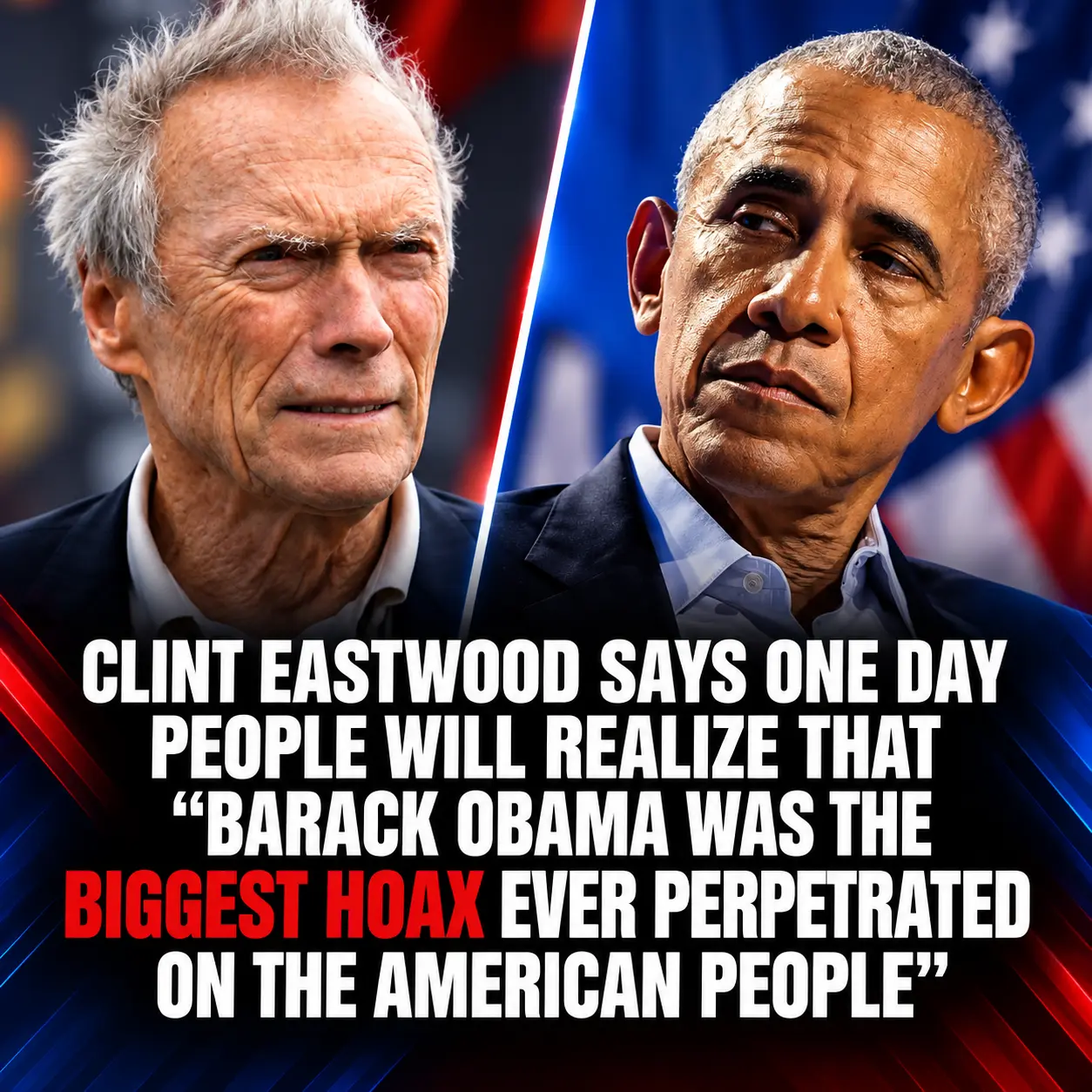
“President Obama is the greatest hoax ever perpetrated on the American people,” Eastwood declared.
The remark would circulate for years, eventually resurfacing through social media posts, political commentary, and a 2018 message from Donald Trump.
What began as an improvised convention appearance became a lasting example of how celebrity political speech, internet culture, and partisan debate can collide.
The story is not about a newly issued statement. It is about what Eastwood said in 2012, why the remarks attracted attention, and how their meaning was subsequently debated and sometimes distorted.


6
The Night an Empty Chair Stole the Spotlight
On August 30, 2012, the Republican National Convention was preparing for one of the most important moments of Mitt Romney's presidential campaign.
Romney, the former governor of Massachusetts, was about to formally accept his party's nomination to challenge incumbent President Barack Obama.
Political conventions are carefully organized events. Speeches are generally prepared, messages are coordinated, and the schedule is designed to focus attention on the presidential nominee.
Eastwood's appearance disrupted that familiar pattern.
At 82 years old, the celebrated actor and director arrived onstage as a surprise guest. He was already known for films such as Dirty Harry, Unforgiven, and Million Dollar Baby, and his reputation extended across generations of moviegoers.
Rather than delivering a conventional endorsement, Eastwood turned toward an empty chair.
He introduced the chair as a stand-in for Obama and proceeded to question the imaginary president about his campaign promises, the economy, and his administration's record.
The exchange was entirely one-sided.
Eastwood supplied both his own questions and the implied responses of the absent president, occasionally reacting as though Obama had interrupted or challenged him.
Some delegates laughed and applauded. Other viewers struggled to understand the unusual performance.
What was supposed to be a brief appearance extended to approximately 12 minutes.
Within hours, the chair had become almost as famous as the speech itself.

ABC News
+1
A Performance That Was Never Planned
One of the most surprising details emerged a week later.
The empty-chair routine had not been developed by Republican campaign strategists or carefully rehearsed before the convention.
According to Eastwood's September 7 interview with the Carmel Pine Cone, the idea occurred to him shortly before he walked onstage.
While waiting backstage, he noticed a stool.
A staff member repeatedly asked whether he wanted to sit down.
Instead, the furniture inspired a theatrical device.
Eastwood decided to place the stool near the podium and pretend that Obama was sitting there.
The concept was simple: create an imaginary conversation with the president and question him about promises Eastwood believed had not been fulfilled.
The actor told the newspaper that he had not provided Romney's campaign with a detailed script.
He also explained that he did not consider himself a traditional political speechmaker.
His experience as an actor and filmmaker had taught him how to communicate with audiences, but he approached political speaking differently from professional politicians.
This distinction became central to his explanation.
Eastwood saw the spontaneous routine as an opportunity to communicate in an informal, unscripted manner.
ABC News and the Los Angeles Times independently reported his explanation shortly after the interview appeared.

Los Angeles Times
+1
The Interview That Produced the Controversial Quote

cbsnews.com
The Carmel Pine Cone interview became important for another reason.
Eastwood did not retreat from his criticism of Obama.
Instead, he delivered the statement that would become one of his most frequently repeated political quotations:
“President Obama is the greatest hoax ever perpetrated on the American people.”
The language was unusually severe, particularly coming from an internationally recognized filmmaker.
Eastwood also expressed his belief that Romney and running mate Paul Ryan would govern more effectively.
His remarks were part of a broader political argument about Obama's performance in office, not a substantiated finding that Obama's presidency was fraudulent.
That distinction matters because the word hoax can imply deception, but Eastwood's statement was an expression of political judgment.
It did not establish criminal misconduct, election fraud, or any other specific wrongdoing by Obama.
The original interview shows that Eastwood was expressing dissatisfaction with the administration's record and advocating a change in political leadership.
CBS News and The Guardian both reported the quotation in September 2012, confirming that it was not a phrase invented years later by social media users.

CBS News
+1
Why Eastwood Refused to Apologize
The actor's reaction to criticism was consistent with the independent public image he had cultivated throughout his career.
Eastwood acknowledged that his convention performance was unconventional.
He also recognized that it had irritated political opponents.
But he explained that his intended audience was not necessarily committed Republicans or Democrats.
He wanted to reach voters who had not firmly aligned themselves with either side.
This helps explain why he rejected the idea of delivering a polished, heavily scripted political speech.
To Eastwood, the informal presentation was a contrast to the carefully managed language commonly heard at national conventions.
His supporters interpreted that spontaneity as authenticity.
Critics regarded it as disorganized and distracting.
Both reactions contributed to the extraordinary attention the performance received.
Eastwood did not apologize for using the chair or withdraw his political assessment of Obama.
The Carmel Pine Cone interview presented him as satisfied that he had communicated his position, regardless of how commentators evaluated the performance.

ksbw.com
+1
The Internet Turns a Political Speech Into a Meme

cbsnews.com
Social media transformed the episode almost immediately.
The term Eastwooding emerged as internet users photographed empty chairs and created jokes referencing the actor's performance.
Some images placed empty chairs in unusual settings.
Others portrayed imaginary conversations with absent political figures.
The trend became an early example of how political events could be transformed into viral visual culture.
Instead of discussing only the substance of Eastwood's criticisms, many online conversations focused on the chair itself.
For Romney's campaign, that created an unusual communications problem.
The final night of a presidential convention is intended to emphasize the nominee's message.
Yet the most memorable image for many viewers was not Romney standing before the delegates.
It was Eastwood addressing an empty piece of furniture.
CBS News reported that the improvised performance surprised viewers and campaign officials alike.
CBS News
The moment demonstrated that celebrity appearances can attract attention without necessarily producing the intended political message.
It also illustrated the unpredictable relationship between traditional television events and internet culture.
A speech lasting only minutes can generate imagery and phrases that circulate for years.
Hollywood Fame Meets Presidential Politics
Eastwood's political involvement was not entirely unexpected.
Long before the 2012 convention, he had served as mayor of Carmel-by-the-Sea, California, from 1986 to 1988.
His public career therefore combined entertainment, local government, and occasional national political commentary.
Nevertheless, his Hollywood reputation remained central to the public reaction.
Eastwood was not merely another political speaker.
He was an actor associated with characters who challenged authority, delivered memorable lines, and relied on personal judgment rather than institutional approval.
For some viewers, the empty-chair performance reflected those familiar screen qualities.
For others, it exposed the difficulty of translating cinematic confidence into live political communication.
The distinction between Eastwood the filmmaker and Eastwood the political participant became increasingly blurred.
His films were familiar to audiences with a wide variety of political beliefs.
His convention appearance, however, placed him directly within a partisan presidential campaign.
That created an entirely different kind of public debate.
Viewers were no longer discussing his direction, performances, or cinematic legacy.
They were evaluating his political statements and their possible implications.
Obama's Record and the 2012 Political Climate

Eastwood's remarks emerged during a presidential election shaped by economic concerns.
The United States was still recovering from the financial crisis and Great Recession.
Unemployment, government spending, economic growth, and the federal budget were prominent campaign issues.
Romney argued that his business background and economic proposals would produce stronger growth.
Obama defended his administration's response to the crisis and argued that the recovery required continued investment and policy stability.
Eastwood's criticism reflected dissatisfaction with Obama's economic performance and campaign promises.
His empty-chair routine emphasized those themes.
But his political conclusions should not be confused with an objective assessment of the entire Obama presidency.
Evaluating an administration requires examining economic data, legislative achievements, foreign policy decisions, and broader historical circumstances.
Different observers can place different weight on those factors.
Eastwood's statement was one highly publicized expression of opposition during a competitive presidential election.
It was not a comprehensive evaluation supported by a defined set of measurable criteria.
Why the Remark Continued Circulating
Political quotations often survive long after the events that produced them.
Eastwood's statement had several characteristics that made it particularly easy to share.
It was short, provocative, and attributed to a famous person.
It involved a sitting president and came from an actor whose public image was associated with blunt language.
It also followed a televised moment that millions of people had already seen.
Together, those elements gave the quotation an enduring presence in political discussions.
The statement could be reposted without the surrounding interview, making it easy for readers to encounter the words without knowing when or why they were spoken.
Over time, that separation from the original context became increasingly important.
A person encountering the quote years later might reasonably assume that Eastwood had recently made a new political announcement.
In reality, the remark originated in September 2012.
Its later circulation did not change its date or meaning.
The distinction between a newly reported statement and an old quotation resurfacing is essential to accurate political reporting.
Donald Trump Brings the Quote Back Into View

cnbc.com
Donald Trump helped give Eastwood's remark another burst of political attention.
However, the timing is often misstated.
Although the quote circulated prominently in 2018, PolitiFact documented that Trump had actually posted Eastwood's words on September 10, 2012, just days after the Carmel Pine Cone interview.
This is an important correction to accounts suggesting Trump first shared the statement in 2018.

PolitiFact
By 2018, Trump had become president, and old criticisms of Obama were again circulating widely among political commentators and social media users.
The connection between the two men was especially interesting because Eastwood's relationship with Trump was not consistently supportive.
Eastwood had expressed a preference for Trump over Hillary Clinton in 2016, but later criticized aspects of Trump's public behavior.
In 2020, he said he wished Trump would conduct himself more courteously and indicated support for Michael Bloomberg during the Democratic presidential primary.
Those later statements complicate attempts to portray Eastwood's 2012 criticism of Obama as proof of an enduring alliance with Trump.

PolitiFact
The filmmaker's political opinions have changed or varied across different elections.
His statements should therefore be understood within their particular historical circumstances.
What PolitiFact Actually Found

abc.net.au
In November 2018, PolitiFact examined a viral Facebook image that attributed a modified version of the Obama quotation to Eastwood.
The social media version claimed that Eastwood had described the Obama presidency as the biggest fraud perpetrated against Americans.
The wording was not identical to the original interview.
Eastwood had referred to Obama personally and used the word hoax, rather than the phrase biggest fraud.
PolitiFact nevertheless concluded that the viral paraphrase closely reflected the meaning of the original statement, rating the attribution Mostly True.
The fact-check confirmed that the underlying remark was genuine, while identifying the differences between Eastwood's actual words and the version circulating online.
PolitiFact
That conclusion is narrower than an endorsement of Eastwood's political opinion.
A fact-check can establish that someone made a statement without validating the statement's substance.
PolitiFact was evaluating whether the quotation had been accurately attributed, not whether Obama's presidency was a deception.
The distinction is particularly important when reporting controversial political language.
When Authentic Quotes Become Fabricated Statements
The original Eastwood quotation was genuine, but other messages attributed to him were not.
In 2019, PolitiFact investigated a lengthy social media statement that portrayed Eastwood as delivering an extended denunciation of Obama.
The organization found no evidence that he had authored the circulating message.
It rated the attribution Pants on Fire.
Similar false quotations later appeared involving Joe Biden.
PolitiFact again found that the statements had been misattributed to Eastwood.
PolitiFact
+1
These examples reveal a common pattern in online political communication.
A genuine controversial statement can make additional fabricated statements appear more believable.
Once audiences associate a celebrity with a particular political position, false quotations expressing similar views may spread more easily.
That makes the original source especially important.
In Eastwood's case, the September 2012 Carmel Pine Cone interview provides the historical foundation for the authentic remark.
Later social media variations should be checked against that source rather than accepted automatically.
The Legacy of a Remarkable Political Moment
More than a decade after the Republican convention, Eastwood's empty-chair performance remains an unusual episode in the relationship between American entertainment and presidential politics.
It was neither a traditional campaign speech nor a conventional comedy routine.
It was an improvised performance by a major Hollywood figure who wanted to express dissatisfaction with a sitting president.
Its reception demonstrated how dramatically the same event could be interpreted by different audiences.
Some viewers appreciated the humor and informality.
Others criticized the presentation and questioned whether it distracted from Romney's nomination.
The internet gave the moment an afterlife far beyond the convention hall.
And the subsequent newspaper interview ensured that Eastwood's political views would remain associated with the event.
His description of Obama as a hoax became the most enduring verbal expression of that criticism.
Yet the historical record is more specific than the viral versions sometimes suggest.
Eastwood made the statement in 2012. It was an expression of political opposition, not evidence of fraud. Trump repeated the quotation in September of that year, and PolitiFact later confirmed the authenticity of its essential wording.
The empty chair, meanwhile, remains an example of how a spontaneous decision can become the defining image of a carefully organized political event.
For Eastwood, the performance was an opportunity to speak outside the conventions of campaign politics.
For the public, it became a lasting reminder that celebrity involvement in elections can generate consequences no speechwriter or campaign manager fully anticipates.
And for readers encountering the quotation today, the most revealing part of the story may be not simply what Eastwood said, but how his words continued to circulate, evolve, and acquire new meanings long after the original interview.