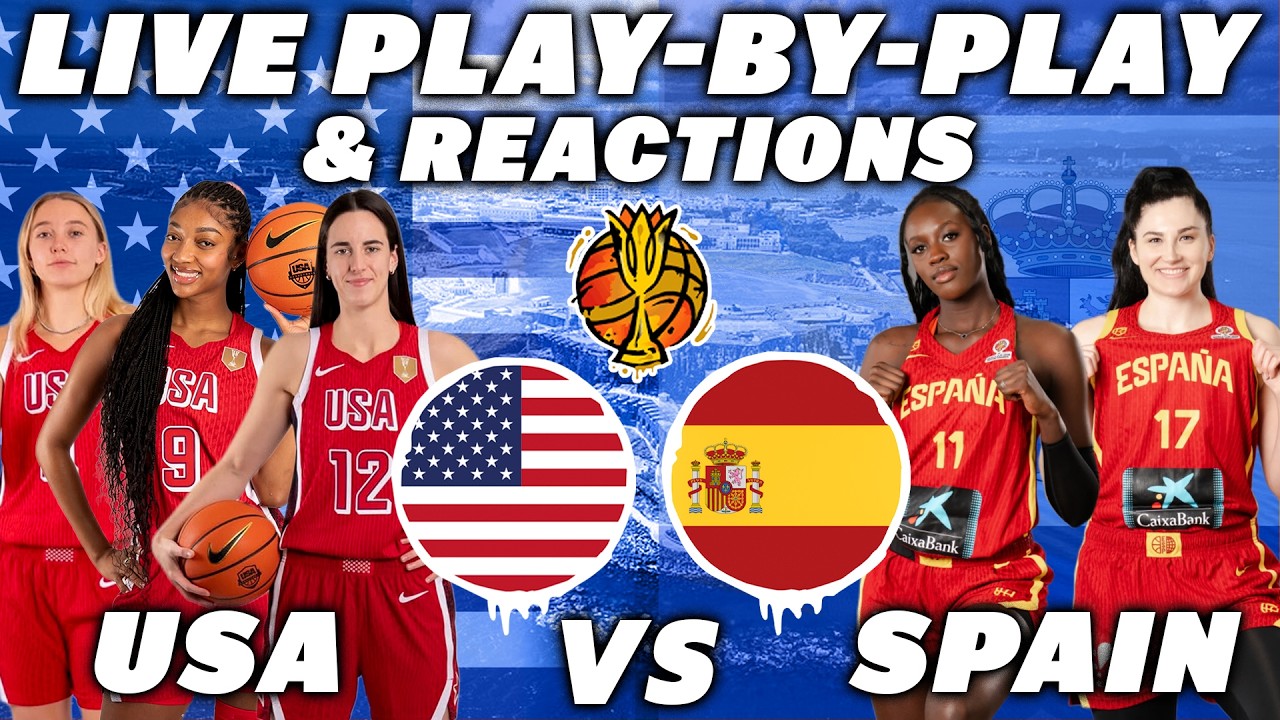
🚨🔥 MATCHUP ALERT: TEAM USA VS. SPAIN - FIBA SEMIFINAL SHOWDOWN CONFIRMED, KEY MATCHUPS, PLAYERS TO WATCH, TIP-OFF TIME & FULL GAME DETAILS! 🇺🇸🇪🇸🏀
Caitlin Clark and Team USA are now just one win away from the World Cup Final, but Spain stands directly in their path with enough size, experience and confidence to make this a serious test.
👀 FULL BREAKDOWN IN THE FIRST COMMENT BELOW 👇

The championship dream has reached its most demanding stage. Team USA and Spain are preparing for a semifinal in which every possession carries enormous consequences, and for Caitlin Clark, the matchup represents another opportunity to perform when the pressure is at its highest.
Indiana Fever fans will naturally have their attention fixed on Clark. Her ability to shoot from extraordinary distances, create opportunities for teammates and accelerate an offense in transition gives Team USA a unique weapon. But Spain has the size, structure and international experience to make this anything but a comfortable path toward the final.
The first major question will be tempo.
Team USA becomes especially dangerous when defense immediately turns into offense. A rebound, steal or deflection can become a scoring opportunity within seconds, and Clark is one of the players capable of transforming those moments into instant pressure.
When Clark receives the ball in transition, defenders have several problems to solve simultaneously.
She can attack the basket.
She can find a teammate running ahead.
She can locate a shooter filling the wing.
And because of her range, defenders cannot simply retreat toward the paint and wait for her to arrive.
That means Spain must control its own offense carefully.
A careless turnover against Team USA is more than a lost possession. It can become an American layup or open three before Spain establishes its defense.
Shot selection matters for the same reason. Spain cannot repeatedly take difficult attempts while leaving too many players around the offensive basket.
Team USA wants chaos.
Spain may prefer control.
Whoever determines that rhythm could gain an enormous advantage.
If Spain manages to slow the Americans, the semifinal becomes a half-court chess match. That is where Clark’s shooting gravity becomes particularly valuable.
Her impact begins before she takes a shot.

A defender assigned to Clark often needs to remain connected several feet beyond the conventional three-point line. That stretches the defense and creates additional space elsewhere.
Driving lanes become larger.
Interior players receive more room.
Screens become more difficult to defend.
Help defenders must travel farther.
Spain therefore faces a difficult choice.
Stay tightly connected to Clark and potentially create opportunities for her teammates, or provide additional help elsewhere and risk allowing one of basketball’s most dangerous perimeter shooters to find daylight.
Spain could also attack Clark aggressively with traps.
Indiana Fever supporters have already seen how frequently opponents use this strategy. A second defender arrives around the ball screen, attempting to remove Clark from the possession.
The solution is not necessarily asking Clark to defeat two defenders.
The solution is punishing Spain for sending the second defender.
Clark needs to recognize the pressure early and make the escape pass. From there, Team USA must attack before Spain can recover.
A quick drive could force another rotation.
One extra pass could create an open three.
A touch inside could collapse the entire defense.
But speed is essential.
If Team USA hesitates, Spain can reset.
That makes the semifinal an important test not only of Clark, but of the chemistry surrounding her.
Another matchup Fever fans should watch closely involves Clark without the basketball.
When she plays for Indiana, Clark frequently serves as the primary initiator. On a talent-rich international roster, she can spend additional possessions operating away from the ball.
That creates another layer of difficulty for Spain.
After passing, Clark can relocate behind the arc.
She can use an off-ball screen.
She can cut when her defender turns toward the basketball.
She can disappear from one side of the floor before reappearing in another shooting window.
For Indiana, that development could eventually become extremely valuable.
WNBA opponents will continue designing defenses around Clark. The more effective she becomes without possession, the more difficult those schemes become.
Trap her and she can pass before relocating.
Deny her initial touch and Indiana can run her through another action.
Switch against her and the Fever can search for the mismatch.
Stay attached to her and someone else receives additional room.
That is how an offense turns defensive attention into opportunity.
Spain’s size could present another serious challenge.
Team USA cannot expect to win simply through perimeter skill. The Americans will need to compete around the basket, protect the defensive glass and prevent Spain from generating repeated second-chance opportunities.
Rebounding could quietly become one of the most important statistics of the semifinal.
A defensive possession does not end when Spain misses.
It ends when Team USA secures the basketball.
An offensive rebound gives Spain another scoring opportunity and, equally importantly, prevents Clark from launching a transition attack.
For Team USA, rebounding is therefore connected directly to pace.
Spain faces the opposite calculation.
Sending multiple players toward the offensive glass increases its chances of securing second opportunities. But if Team USA controls the rebound, fewer Spanish defenders may be positioned to retreat.
Against Clark’s passing vision, that can become dangerous immediately.
The perimeter battle will matter just as much.
If Spain begins making outside shots consistently, Team USA will have to extend its defense.
That produces longer closeouts.
Longer closeouts create driving lanes.
The Americans must remain disciplined.
Close too slowly and Spain gets an open three.
Attack too aggressively and the shooter can drive around the defender.
Team USA’s help defense must remain connected throughout the possession.
Communication will be critical.
Bench production could also become decisive.
Semifinal basketball demands tremendous energy. Defensive pressure increases, screens become more physical and every loose ball suddenly feels like a season-defining possession.
Team USA’s depth is valuable only if the players entering the game maintain the same organization and intensity.
Spain will be searching for moments when the Americans relax.
A semifinal can swing remarkably quickly.
One turnover becomes a transition basket.
A missed shot follows.
Then Clark or another American shooter knocks down a three.
Within a minute, a close contest can become a significant deficit.
Spain needs to prevent those avalanche stretches.
Team USA wants to create them without becoming careless.
That balance becomes even more important if the score remains tight in the fourth quarter.
Late-game possessions are different.
Coaches target matchups.
Defenses become more aggressive against primary creators.
The pace often slows.
Every turnover becomes magnified.
Clark’s decision-making could become one of Team USA’s greatest assets in those moments.
If Spain traps, release the basketball early.
If Spain switches, recognize the matchup.
If the defender retreats, consider the shot.
If two defenders commit toward Clark, trust the teammate who becomes open.
Sometimes the decisive Clark play will be a deep three.
Sometimes it could be a transition pass.
And sometimes it may simply be the first pass that forces Spain into a rotation before another American player scores.
Mental composure will matter enormously as well.
Team USA enters with championship expectations. Spain enters knowing it needs only one exceptional performance to change the entire tournament.
If Spain opens with a strong run, Team USA cannot panic.
One missed shot cannot become another rushed attempt.
One turnover cannot become a defensive breakdown.
The Americans must continue executing possession after possession.
For Fever fans, those pressure situations are particularly valuable to watch because Clark faces similar challenges in the WNBA. Opponents regularly load defenses toward her, deny her space and attempt to make every possession physically exhausting.
International elimination basketball offers another laboratory for finding solutions.
So when the semifinal begins, do not watch only Clark’s scoring total.
Watch where Spain begins defending her.
Watch how quickly the second defender arrives.
Watch how Clark responds to traps.
Watch her movement after passing.
Watch how Spain’s defense shifts simply because of where she is standing.
Those details can reveal an impact that a traditional box score cannot completely measure.
Fans looking for the precise tip-off time, television channel and authorized live-streaming options should confirm the latest official FIBA and regional broadcaster listings for their market, since coverage can vary by location.
Once the ball goes up, however, the equation becomes simple.
🇺🇸 Team USA vs. 🇪🇸 Spain.
One semifinal.
One victory from the World Cup Final.
For Caitlin Clark, it is another chance to demonstrate that her influence extends far beyond spectacular shooting. For Indiana Fever supporters, it is another opportunity to watch their star guard solve increasingly difficult defensive problems when every possession matters and a place in the championship game is waiting on the other side.