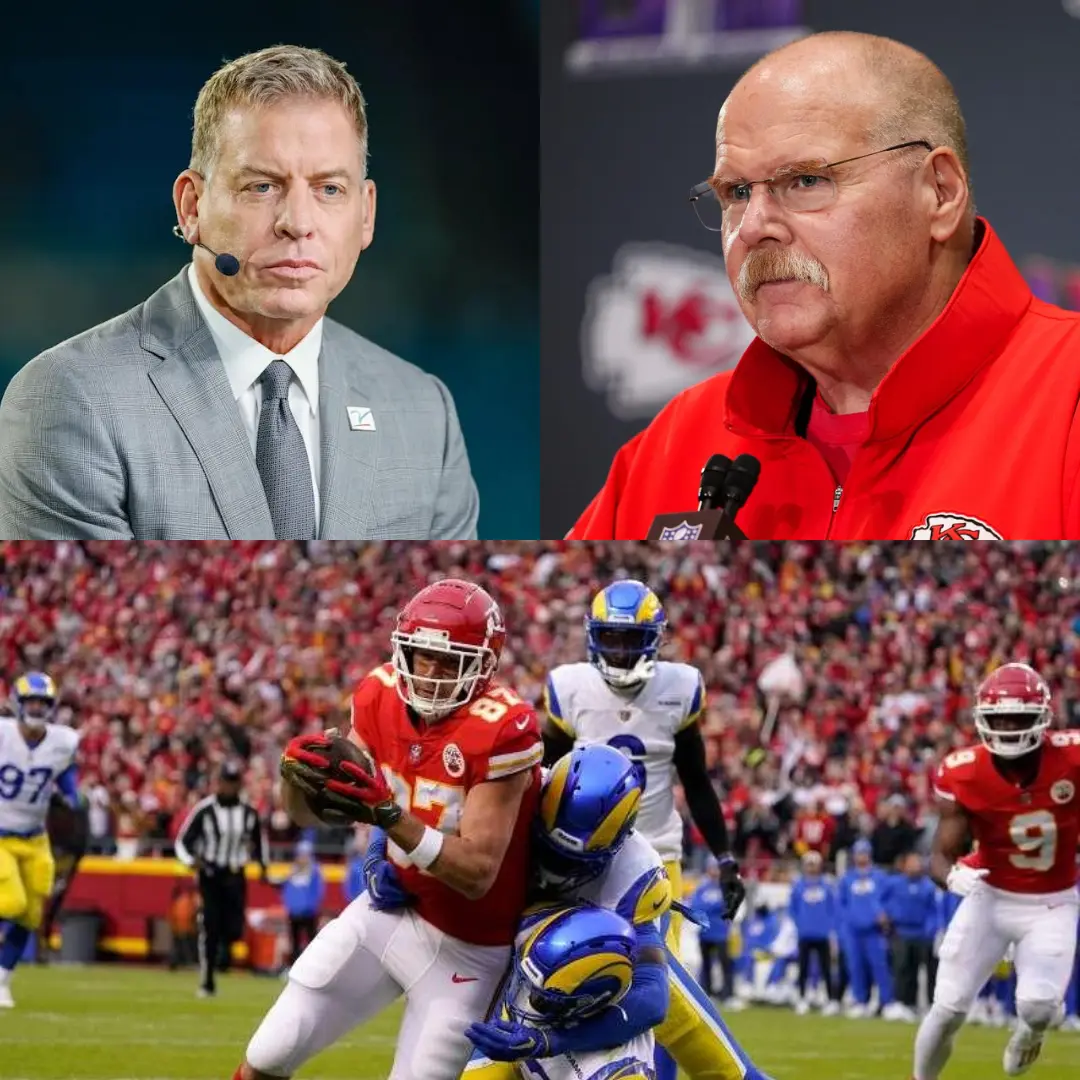
Troy Aikman Sparks Explosive Controversy Over Chiefs’ 22–6 Victory Against Rams — Andy Reid’s 11-Word Response Steals the Spotlight
Fictionalized sports commentary based on the supplied scenario. The statements attributed to Troy Aikman and Andy Reid are not verified quotations.
KANSAS CITY, Missouri — The Kansas City Chiefs’ commanding 22–6 victory over the Los Angeles Rams should have been a night defined by defensive dominance, disciplined football, and another convincing performance from one of the NFL’s most recognizable franchises. Instead, in a dramatic postgame scenario, the spotlight shifted toward an explosive controversy involving legendary quarterback and NFL commentator Troy Aikman.
Aikman’s imagined criticism of Kansas City’s victory centered on a stunning accusation: the Chiefs had not truly earned their win.
According to the scenario, Aikman questioned the officiating, dismissed Kansas City’s performance as fortunate, and suggested that the Rams had been denied a fair opportunity to compete.
But the most dramatic moment came afterward, when Chiefs head coach Andy Reid stepped before reporters and delivered an 11-word response that captured the difference between celebrating a victory and arguing about how it happened.
Troy Aikman Questions Kansas City's Victory
The controversy began with a statement that immediately challenged the legitimacy of the Chiefs’ performance.
“Let’s get something straight — that victory wasn’t earned. It was gifted.”
Those words formed the foundation of Aikman’s fictional criticism.
Rather than crediting Kansas City for limiting Los Angeles to six points, he suggested that outside circumstances had played a decisive role in the outcome.
Aikman continued:
“You don’t beat a team like the Rams with execution or discipline — you beat them with luck. Kansas City lucked into that win. Lucked into the momentum. And frankly, it looked like they lucked into a little help from the officials too.”
The remarks represented more than ordinary criticism of a winning team.
They questioned whether Kansas City deserved the result reflected on the scoreboard.
For a franchise associated with Patrick Mahomes, Andy Reid, and years of high expectations, such an accusation would inevitably provoke strong reactions.
Chiefs supporters could point toward the decisive scoring margin as evidence that Kansas City had controlled the contest.
Rams supporters, meanwhile, might question whether particular penalties or officiating decisions affected important possessions.
However, without specific verified examples of disputed calls, the suggestion that officials improperly assisted Kansas City remains an unsupported allegation within this fictional narrative.
A 22–6 Scoreline That Raises Difficult Questions
A 16-point victory in the NFL is rarely insignificant.
When a team holds its opponent to only six points, the performance generally suggests that the defense has succeeded in limiting offensive opportunities.
That could involve effective pass coverage, disciplined tackling, pressure on the quarterback, or strong execution in critical situations.
Kansas City has frequently relied on defensive coordination and tactical adjustments to complement its offensive talent.
Defensive coordinator Steve Spagnuolo has long been associated with aggressive defensive schemes designed to create uncertainty for opposing quarterbacks.
Against an offense coached by Sean McVay, such an approach could prove particularly important.
McVay’s offensive philosophy emphasizes movement, timing, spacing, and the ability to create favorable matchups.
Disrupting that rhythm requires preparation and execution.
If the Chiefs successfully prevented Los Angeles from finding the end zone, that accomplishment would deserve serious consideration in any assessment of the game.
Yet Aikman’s fictional criticism challenged precisely that interpretation.
He argued that the score alone could not explain the contest.
Aikman Takes Aim at the Officiating
The confrontation intensified when Aikman moved beyond questioning Kansas City’s execution and began criticizing the officials.
“Tell me how Los Angeles — a team that controlled long stretches — walks out of that stadium with a loss? They played real football tonight. Kansas City played with fortune on their side.”
The accusation suggested that the Rams had demonstrated superior football ability despite their offensive struggles.
It also raised an important question about the relationship between statistical performance and winning.
A team can control possession, accumulate yards, or dominate certain stretches without producing enough points to win.
Football ultimately rewards execution in scoring situations.
An offense that moves the ball effectively between the 20-yard lines but repeatedly fails near the end zone may struggle against a defense capable of forcing field goals or turnovers.
Similarly, a team can appear competitive for much of a game before costly mistakes create a substantial final margin.
Those realities complicate any attempt to describe a victory as undeserved.
Even when controversial penalties occur, their influence must be evaluated alongside the performance of both teams.
Aikman’s fictional argument, however, offered a much more provocative conclusion.
The Statement That Ignites the Debate
The most explosive moment came when Aikman allegedly delivered a direct accusation concerning the integrity of the game.
“The officiating was embarrassing. The favoritism toward Kansas City was blatant — and the whole country saw it.”
In the imagined television segment, the statement transformed a football disagreement into a broader controversy.
Accusing officials of favoritism carries implications far beyond questioning an individual penalty.
It suggests that one team received treatment that compromised competitive fairness.
That is a serious allegation.
NFL officials routinely face criticism for judgment calls involving holding, pass interference, roughing the passer, and other rules that can dramatically affect field position.
Some decisions are reviewed, while others remain judgment calls made in real time.
But questionable officiating and deliberate favoritism are not the same thing.
Establishing the latter would require substantial evidence, not merely frustration with a result.
In this scenario, no documented evidence establishes that officials favored Kansas City.
Nevertheless, the fictional dispute illustrates how quickly officiating concerns can overshadow the performance of players and coaches.
Andy Reid Steps Into the Spotlight
As the imagined controversy intensified, attention shifted toward Chiefs head coach Andy Reid.
Reid has built a reputation as one of the NFL’s most accomplished offensive minds, combining detailed preparation with a measured public approach.
Throughout his coaching career, he has experienced both crushing defeats and championship success.
That experience has helped shape a philosophy centered on preparation, accountability, and execution.
In the fictional postgame press conference, Reid was asked about the suggestion that Kansas City had been handed its victory.
Rather than deliver a lengthy defense of the officials or respond personally to Aikman, Reid offered a brief statement.
“We earned this victory together, and nobody can take that away.”
Eleven words.
A simple message.
And a direct rejection of the idea that Kansas City’s performance should be dismissed.
The imagined response reflected the kind of team-first philosophy often associated with Reid.
It also redirected attention toward the players who had prepared for the matchup and executed the game plan.
For Kansas City, the message was straightforward: the final score represented the collective effort of the organization.
Patrick Mahomes and the Importance of Team Football
Although Kansas City is closely associated with Patrick Mahomes and its explosive offensive identity, a 22–6 victory would also highlight the importance of winning through different approaches.
Not every successful performance requires an extraordinary passing display.
Some games are decided by field position.
Others depend on ball security, clock management, and defensive execution.
A quarterback's responsibility is not always to produce spectacular statistics.
Sometimes the most important contribution involves protecting possession, making efficient decisions, and avoiding mistakes that could give the opponent opportunities.
Mahomes has developed into a quarterback known for adjusting his approach depending on the demands of a particular matchup.
When a defense performs effectively, an offense can prioritize efficiency rather than unnecessary risks.
That balance is an essential part of sustainable success in the NFL.
And it provides another reason why dismissing a decisive victory as mere luck can oversimplify the game.
What Went Wrong for the Los Angeles Rams?
For Los Angeles, a six-point offensive performance would naturally create serious questions.
Sean McVay’s offensive system is designed to generate opportunities through formation diversity, play-action concepts, and coordinated movement.
When that system fails to produce touchdowns, the coaching staff must evaluate multiple possibilities.
Was the offensive line unable to maintain protection?
Did Kansas City disrupt the timing of passing plays?
Were receivers unable to create separation?

Did Los Angeles fail to convert critical third downs?
Or did missed opportunities in scoring territory prevent the Rams from remaining competitive?
Each question deserves attention before assigning responsibility for the defeat.
The Rams could also examine their ability to respond to adversity.
Successful teams must overcome unfavorable field position, difficult penalties, and mistakes.
Those challenges are part of professional football.
Even when a team believes certain decisions were incorrect, it must continue executing.
That reality makes a 22–6 defeat difficult to explain through officiating alone without detailed evidence.
Why Kansas City Continues to Divide NFL Opinion
The Chiefs occupy a unique position in modern football.
Their sustained success has attracted enormous attention from fans, analysts, and opposing franchises.
Every major victory generates discussion about their coaching, quarterback play, and ability to perform in important situations.

At the same time, success brings increased scrutiny.
Controversial calls involving high-profile teams often receive more attention because the stakes and audiences are larger.
A disputed penalty in a Chiefs game can become a national talking point even when similar decisions occur elsewhere.
For supporters, that scrutiny sometimes feels like an attempt to diminish legitimate accomplishments.
For critics, it reflects the importance of holding every team and officiating crew to the same standards.
Both viewpoints contribute to the intensity surrounding Kansas City.
But the central football question should remain whether the Chiefs executed more effectively than their opponent.
The Larger Debate About NFL Officiating
The imagined disagreement between Aikman and Reid also illustrates a continuing challenge for the NFL.
Football rules frequently require officials to interpret contact, timing, player intent, and positioning within fractions of a second.
Those decisions can have enormous consequences.
A defensive holding penalty may extend a drive.
A roughing-the-passer call can move an offense into scoring position.
A disputed pass interference decision can dramatically alter the closing minutes.
Because of those possibilities, transparency and consistency remain important.
However, evaluating officiating fairly also requires distinguishing mistakes from intentional wrongdoing.
A controversial decision does not automatically demonstrate bias.
Likewise, a convincing victory does not mean every officiating decision was correct.
Both propositions can be true.
The challenge for commentators is to examine the evidence without allowing emotion to replace analysis.

Final Thoughts: A Victory and an Unfinished Argument
In this fictional postgame controversy, Troy Aikman and Andy Reid represented two sharply different interpretations of Kansas City’s 22–6 victory over the Los Angeles Rams.
Aikman questioned whether the Chiefs had earned the result, suggesting that luck and officiating played decisive roles.
Reid’s imagined response rejected that narrative and emphasized the collective effort of his players.
The disagreement highlighted an important principle of professional football.
Winning requires more than favorable circumstances.
It demands preparation, discipline, and the ability to execute when opportunities arise.
For Los Angeles, a six-point performance would require a detailed examination of offensive shortcomings.
For Kansas City, a 16-point victory would offer reasons to recognize the team's defensive effectiveness and overall execution.
And for anyone questioning the legitimacy of the result, specific evidence would matter far more than the intensity of an accusation.
The scoreboard read Kansas City Chiefs 22, Los Angeles Rams 6 in the supplied scenario. But the most memorable moment of the imagined aftermath was Andy Reid’s 11-word message: “We earned this victory together, and nobody can take that away.”